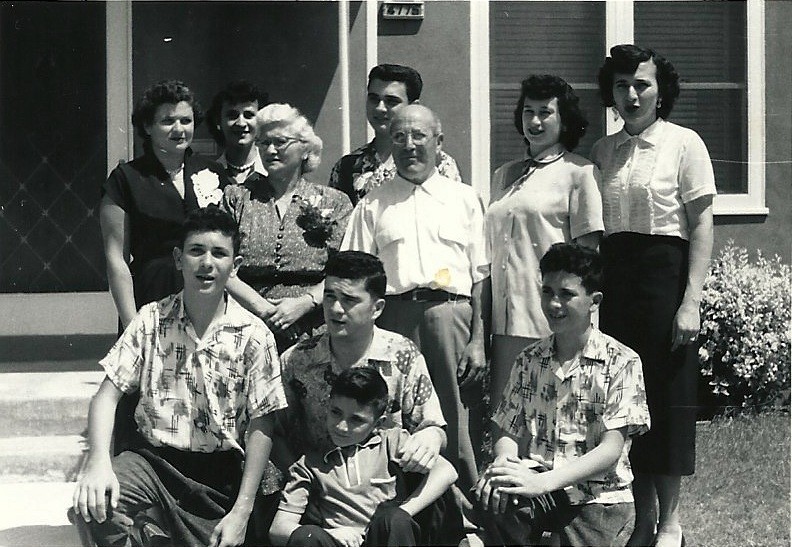
In my grandparents’ families, as in most Sicilian peasant households, people didn’t travel for leisure. My paternal grandparents had never left Sicily. I used to keep photos of the only trip my maternal grandparents took together—a honeymoon to Rome and Naples. But at my grandparents’ house, there was a ceramic cup filled with coins from various eras and places. Many were Italian lira coins from the 1940s onwards. And then there were a few foreign coins. Some featured a kangaroo on the back.
My maternal grandfather had been to Australia for about two years in the early 1950s, before getting married. He had run a fruit shop in Sydney. His father and uncle had also been to Australia before him. His father, my great-grandfather—already married with two children—spent nearly twenty years in Australia, including, as I discovered, a year of internment in a prison camp during World War II.
I know that even today, the descendants of some of my grandfather’s cousins live in Sydney—I still keep a few letters from the 1990s exchanged between my grandfather and his aunt.
Australia. A place so far away that I wonder what it could have evoked in the imaginations of my ancestors, born and raised entirely in a rural world far from the cities. How did it happen that Sicilian peasants came to view Australia of all places as a formidable destination upon which to project their hopes for a better life?
Although the boom in Sicilian emigration to Australia occurred after World War II, the first Sicilians had begun arriving far earlier—starting as early as the 1870s, when the word Australia must have carried the allure of an untouched world, rich with promises of work and abundance.
The earliest Sicilian migrants were mostly young men drawn to areas with a high demand for manual labor. One of the first regions to become a destination for these pioneers was Queensland, on the eastern coast.
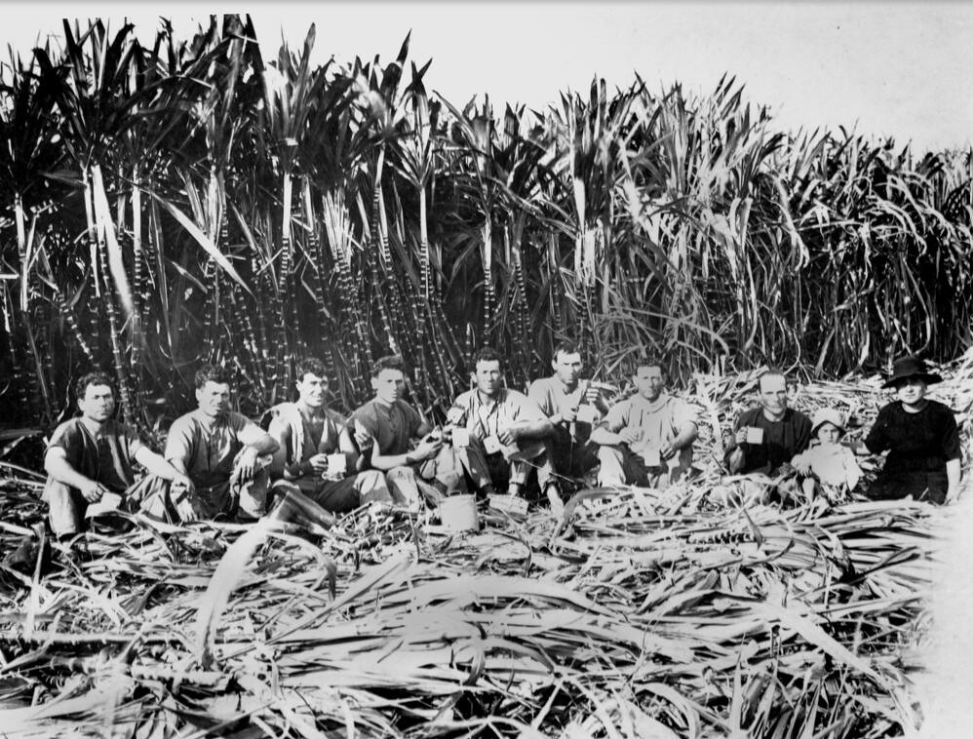
In the late 19th century, Queensland was covered in sugar cane plantations. Initially, it was primarily workers from various Pacific Islands who cultivated them, cutting the cane by hand. However, starting in 1901, the “White Australia policy” progressively banned the arrival of non-European immigrants to maintain a predominantly white population. Attempts were made to replace them with Irish and Scandinavian laborers, who proved unsuited to such grueling work in a tropical climate. Attention then turned to Italians, particularly Sicilians, even though there were reservations about whether they were truly “white.” In subsequent years, they became the targets of numerous denigratory campaigns warning of a calculated “invasion” by these “olive skins”—people whose skin could at best be called olive-toned, but certainly not white.
Despite this, Italian and Sicilian communities in Queensland multiplied. They were predominantly Sicilians from the Mount Etna region, especially after a parasite devastated local vineyards in the 1930s. Nevertheless, upon reaching Queensland, working conditions were harsh: cutting sugar cane was grueling labor, and the lodgings reserved for these workers were little more than shacks, with mattresses stuffed with cane refuse. Yet, little by little, these pioneers began sending for their wives, brothers, and cousins. One family brought over another, and workers often pooled their money to buy sugar cane farms. Even today, many descendants of those Sicilians own agricultural properties there. They imported Sicilian traditions, their language, and their cuisine. They integrated and blended with people of various backgrounds; their children studied and moved to the cities.
And yet, many descendants of Sicilians in Australia continue to faithfully pass down the thread of memory and tradition. They do so through stories, language, and recipes, or by celebrating festivals that bring the whole community together—such as the deeply Sicilian feast dedicated to Santi Alfio, Filadelfo e Cirino, which is still held every May in various Queensland towns. It is an occasion to sing, dance, and cook grandmother’s recipes—and to nurture and keep alive, year after year, their Italian roots.