Tag: genealogy

  • Stories – finding family across the ocean

    Stories – finding family across the ocean

    I exchange messages with Jeanne at the beginning of July, exactly two years since we first spoke. A few days earlier, in Alcamo, Sicily, they celebrated the feast of the Madonna dei Miracoli, the patron saint; Jeanne tells me that her cousins from Alcamo sent her photos of the festival and the procession.

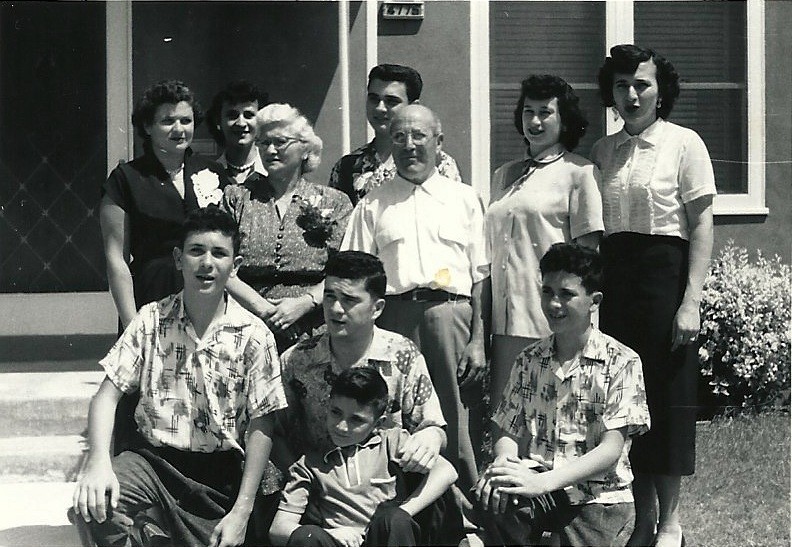
    Between me in Italy and Jeanne in the United States, there is an ocean crossed by dozens of threads. The first was traced by her grandmother, Maria, in 1919. She was 19 years old when she left her – and my – hometown, a town in western Sicily called Alcamo, to board a ship for New York, eventually arriving in Detroit. She was traveling alone. According to the Ellis Island landing documents, she was heading to an uncle. But that wasn’t true. In reality, she was going to America to marry a fellow townsman, a man she probably didn’t know, or at least didn’t know well, following the path of a choice someone else had made for her. Maria would build her family in America, having nine children and many grandchildren—a hybrid family like many at the time, a little Italian and a little American. She returned to Alcamo for a visit in the 1970s, alongside one of her daughters, to reconnect with her family of origin, which by then had grown to include new brothers- and sisters-in-law and grandchildren.

    The descendants of Maria’s American family and the descendants of the family she left behind in Alcamo kept in touch for years, until contact thinned out, memories frayed, and at a certain point, it became difficult for Jeanne—who was planning a trip to Sicily—to track down the part of the family living in Alcamo.

    To help Jeanne find her Sicilian cousins, I followed two paths simultaneously. On one hand, we reconstructed the family history of grandmother Maria, her departure, her siblings, and her in-laws. Meanwhile, I used the clues Jeanne gave me to find someone among my contacts who recognized themselves in her family’s story—it helped immensely, in this case, that I am from Alcamo myself.

    Jeanne was thus able to fulfill a small dream: meeting a part of the Sicilian family she always knew she had, and visiting Alcamo together with her newfound cousins. They, in turn, experienced the emotion of seeing their loved ones in home movies filmed in Alcamo by grandmother Maria during her visit in the 1970s, which Jeanne had brought with her.

    In this way, we added a new thread—certainly not the last—to the dense weave connecting Sicily to the other side of the ocean.
  • Even poor people leave some traces

    Even poor people leave some traces

    Sometimes people think that family trees are the prerogative of noble families. In reality, anyone can begin their genealogical research and derive great satisfaction from it, even those like me, people who descended from many generations of poor and illiterate farmers. Because the truth is that everyone who has lived in Europe, at least in the last four hundred years, has left written traces of their passage on earth.

    Let’s take the example of my great-great-great-grandfather Giovanni, the son of two poor and illiterate farmers, born in Sicily in 1845. Giovanni’s father works in the vineyards, and his mother sews to supplement the family budget. Giovanni has six brothers and sisters, and they all live in a three-room house, which they probably share with the family donkey and other animals. No one in the family can read or write, and decades will pass before one of their descendants learns to do so.

    On the very day Giovanni was born, he was baptized, because at the time great care was taken to ensure that a child would not die without baptism. Thus, his name was recorded in that year’s baptismal register, using the customary Latin formula. The next day, his father went to the town hall to register the baby. Here, all relevant information about the baby was recorded, from the time of birth to the occupation and age of his parents (Southern Italy already had a civil registry office at the time, which would arrive in Northern Italy about twenty years later). Our Giovanni grew up, and in the meantime, his region was annexed to the new Kingdom of Italy. Among the new state’s innovations was compulsory military service. So, in 1865, Giovanni’s name appeared on the conscription lists. This was a twist that shocked his family, but there was nothing they could do: Giovanni was forced to leave for Northern Italy, where he remained for various years. All the most relevant information about him (age, height, hair color, distinguishing features) was transcribed in his matriculation sheet.

    Returning to his hometown, he was finally able to marry Margherita, the girl with whom he had exchanged glances for years. After officially proposing to her family, he went to church and the town hall to organize the wedding. The names of the couple were written on a board of the town hall, so that anyone with a dispute about their union could come forward. No one disputed anything, and so Giovanni and Margherita married in July 1873. The details of their marriage were recorded in Latin in the parish register and in Italian in the civil registry.

    A few years later, two of Giovanni’s brothers left for the United States and listed Giovanni’s address as that of their closest relative in their New York arrival records.

    In the following years, Giovanni and Margherita had eleven children, seven of whom reached adulthood. With each child born, died, or married, Giovanni’s name punctually reappears in parish and civil records. It also appears in notary deeds, when Giovanni and Margherita finally manage to buy a new house with a small plot of land. Until, in 1938, the certificate of his son’s second marriage bears the words “figlio del fu Giovanni.” The word “fu” indicates his father is no longer alive. In fact, Giovanni died in 1936. On his tomb, the family wanted a long epitaph engraved, like those used in the past, extolling the virtues of a good father: yet another earthly trace of Giovanni’s life.

  • Back in the past…until when?

    Back in the past…until when?

    Once upon a time, it was crucial for rulers and powerful figures to claim an important ancestor. Alexander the Great claimed to be descended from Achilles, and Julius Caesar even from the goddess Venus. These were, of course, fictitious genealogies, impossible to prove: however, portraying oneself as a descendant of Achilles (or even a goddess) had a very impressive effect.

    But today, who can boast of having the oldest family tree?

    In Europe, one of the families with the oldest documented genealogy is the Capetian family, a French royal dynasty dating back to 978 AD. This means that, for this family, from the 10th century to the present day, it is possible to trace a proven family tree, generation by generation, through reliable documents. Other royal families, such as the Franco-Italian House of Savoy, boast documented genealogies almost as old.

    But when it comes to our ancestors, poor commoners, how far back can we go in genealogical research? The answer is: it depends. Certainly not to such ancient times, yet it’s not as impossible as it might seem to go back three or four hundred (or even five hundred) years.

    Let’s see how it works in Italy. Here, the fundamental documents for genealogical research are the civil registry and parish registers. The former cover, with variations from region to region, the period from the 19th century to the present day. They were introduced in 1806 by Napoleon, but ceased to exist a few years later, with the fall of the emperor. The regions of southern Italy generally have more complete and continuous civil registry records than the rest of Italy, due to the system introduced in 1816 (1820 in Sicily) by Ferdinand I of Bourbon, King of Naples. In most of central and northern Italy, however, you’ll have to wait until 1866.

    So, if you’re looking for your ancestors in, say, Reggio Calabria, you should be able to easily trace birth, death, and marriage records back to the early decades of the 19th century, while if you’re looking in Turin, it might have a bit more complicated.

    And if we want to go even further back? Here, documents (baptismal, death, marriage, etc.) contained in parish registers can help. These records were compiled in the Catholic world at least from 1563 (but in some churches even earlier), as established by the Council of Trent. These are documents in Latin, which don’t always still exist: many churches have lost all or part of their archives over the centuries, due to fires, floods, or simply because someone decided to “make room.” In my research, however, I have often found documents in parish archives that are useful for reconstructing a family tree back to the mid-16th or early 1700s. For example, if we find, in a church archive, the marriage certificate of a couple of our ancestors who married in 1570, we can deduce that the couple were born around the middle of the century: almost five hundred years ago.